





Hermann Hesse : Thoughts about China (1921)

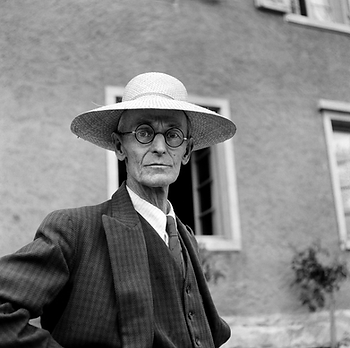
Hermann Hesse
If the War Goes On
Thoughts about China
1921
THE EYES OF THE WORLD are fixed in eager expectation upon a congress now being held in Washington for the purpose of preventing a war between the United States and Japan and limiting the naval armament of the great powers. Its work has been partially successful; something has been accomplished. There will not be a war between Japan and the United States in the foreseeable future, and less money and labor will be squandered on battleships.
The world has been less attentive to another aspect of the discussions in Washington. The great and powerful nations have achieved a certain measure of agreement. But little heed was given to a weak nation that was also present. I am speaking of China. The oldest world power in existence, vast and ancient China, has not chosen the path of adaptation to the Western world that Japan has been following consistently for several decades. China has become very weak; it has virtually ceased to be an independent power and is looked upon by the great powers as little more than a “sphere of influence” to be cautiously divided among them.
Years ago a Chinese devotee of his country’s old and venerable ideas spoke of these developments in terms that have no bearing on politics but are close to the spirit of the Tao Tê Ching. He spoke roughly as follows:
Let the Japanese or other nations conquer us, take possession of our country, and run our government. Let them! It will be seen that we are the weaker, that we can be conquered and gobbled up. Let that happen, if that is China’s destiny! But when the others have gobbled us up, it remains to be seen whether they will be able to digest us. It may well turn out that our government and army, administration and finances will be Japanese, American, and English but that the conquerors will be powerless to change China, that on the contrary they will be conquered and changed by the spirit of China. For China is weak in the art of war and in political organization but rich in life, rich in spirit, rich in ancient culture.
I remembered that amiable Chinese when I read the latest reports from Washington. And I thought: even now, while China though not yet conquered is consummating its decline as a world power, it has conquered a large part of the West! In the last twenty years the ancient Chinese culture, previously known only to the merest handful of scholars, has begun to conquer us through translations of its ancient books, through the influence of its ancient thinking. In the last ten years Lao-tzu has become known through translations into any number of languages and achieved enormous influence throughout Europe. Formerly, until twenty years ago, when we spoke of the “culture of the East,” we thought exclusively of India, of the Vedas, Buddha, and the Bhagavad-Gita. Now, when we speak of East Asian culture, we think equally or perhaps still more of China, of Chinese art, of Lao-tzu, of Chuang-tzu, or Li Po.
And it turns out that for us Europeans the thinking of ancient China, especially that of early Taoism, far from being a mere exotic curiosity, provides significant corroboration of our own thinking, and invaluable counsel and help. Not that from these ancient books of wisdom we can suddenly gain a new and redeeming view of life; not that we ought to cast away our Western culture and become Chinese! But in the ancient Chinese, and especially in Lao-tzu, we find reminders of a mode of thought that we have neglected, a recognition and cultivation of energies that we, busy with other things, have too long disregarded.
I go to the Chinese corner of my library — a peaceful, happy corner! What wisdom there is in these ancient books and how amazingly timely it can be! How often during the terrible war years they yielded up thoughts that consoled and revived my spirits!
Picking up a notebook in which I have jotted down quotations, I read a message from Yang Chu. A man’s attitude toward life, says this Chinese philosopher, possibly a contemporary of Lao-tzu and earlier than Buddha, should be that of a master toward his servant. Then follows the Maxim of the Four Dependencies: “Most men are dependent on four things which they desire too greatly: long life; fame; title and rank; money and possessions.
“It is their unremitting desire for these four things that makes men fear demons and fear one another, that makes them fear the mighty and fear punishment. Every state is built upon this fourfold fear and dependency.
“Men who are prey to these four dependencies live like madmen. They may be slain or they may be permitted to live; in either case destiny comes to these men from without.
“That man, however, who loves his destiny and knows himself to be one with it — cares nothing for long life, for fame, for rank or wealth!
“Such men carry peace within them. Nothing in the world can threaten them, nothing can be hostile to them. They bear their destiny within their own selves!”


