

Journal de guerre d'Alan Seeger (Extrait) : "A desolate village of northern France"

"Most precious were the remains of a beautiful library [...]. Here, stacked just as they were before the invasion, I found finely bound, immaculate sets of Rousseau, Voltaire, Corneille and Racine."

Alan Seeger, Letters and diary (1917)
coll. Irène de Palacio
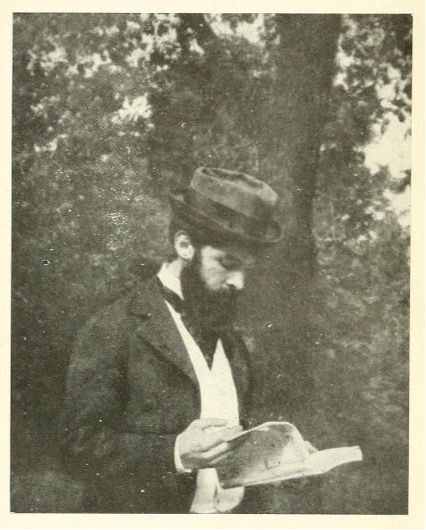
"J'ai un rendez-vous avec la Mort", écrivait le poète-soldat américain Alan Seeger dans son poème le plus célèbre.
Il devait s'y rendre en juillet 1916, au cours de la bataille de la Somme.
Un an auparavant, il arpentait les paysages blessés de la France, pour laquelle il s'était engagé dès 1914, dans la Légion étrangère. Il rendait compte de son expérience de la guerre dans un très beau journal (Letters and diary, publié en 1917), dont est extrait le passage qui va suivre. Tombé sur un de ces paysages de ruines où plus rien ne subsiste que la désolation des combats, Seeger décrit le sentiment que lui procure la vision d'un château autrefois habité par une famille aisée. Là, au cœur de cette demeure dévastée, le bonheur impromptu de découvrir des volumes de littérature classique miraculeusement préservés des pillages offrira au poète un trop rare moment de grâce.
[A lire aussi, sur Anthologia : Le dernier rendez-vous d'Alan Seeger].
A desolate village of northern France
Alan Seeger, Letters and diary — February 5, 1915
(Extrait)
Poor ruined villages of northern France ! There they lie like so many silent graveyards, each little house the tomb of some scattered family's happiness. Where are the simple, peace loving country folk that dwelt here when these windows were squares of yellow lamplight, not, as now, blank as holes in a skull ? The men away at the war or already in their graves ; the women and children refugees in the south, dependent upon charity. The pity of it all is that the French guns have done and have had to do the material damage.
When the Germans marched back in August there was no resistance to their advance. But it was with the artillery close on their heels that they were chased out in September. It is frightful to think that only at such a price can the French regain their conquered territory. If the enemy are to be driven across the frontier does it not mean that every town and village between must be laid in ruins ? The alternative is staggering....
At C— our quarters are most picturesque. They are the wine cellars if the village's two châteaux. Here the soldiers have been able to bring straw, coal and candles, and with a good roof over their heads, safe from shells and from rain, enjoy a degree of comfort quite exceptional for a position where the crack of the German mausers as they snipe at sentinels seems at our very doors and where the mitrailleuse upon the hillside could rake our cellar door itself were it not for the encircling groves.
The big château has been completely burned down. Nothing remains but the shell. It sits in the midst of an immense, heavily wooded park, the wall of which, several kilometers long, forms part of our line of defence. Pretty paths intersect the dense groves. There are benches here and there, fountains and summer houses. The lawn that encircles the château slopes down behind to a charming little artificial lake. Everything bespeaks the pleasure retreat of some man of wealth and taste. Before the ruined mansion, truly seigniorial in its proportions, stand ancestral pines.
Nothing could be more romantic on a moonlit night than the view of these silent walls gleaming amid the great black cones; nothing more eerie than the silent grove, in which there is never the complete assurance that the park wall completely separates one from the lurking enemy.
The little château is in the town itself, surrounded by no considerable estate. It has been ripped open with bombardment, but was not set on fire. Strange enough, the pillaging of six months has not begun to exhaust the loot that litters its floors knee deep. Here are all the possessions of some once comfortable family lie scattered about as they have been pulled from desk, cupboard and bureau. Sheets and pillowcases lie mixed up with family photographs and correspondence in a chaos of disorder.
Most pathetic to me was a little girl's postcard collection—cards from all over Europe, with their little messages of love or greeting. But most precious were the remains of a beautiful library, the last thing to be violated by the rude hands that have ransacked everything else and left not a bottle of wine in the whole town. Here, stacked just as they were before the invasion, I found finely bound, immaculate sets of Rousseau, Voltaire, Corneille and Racine. The wind and rain that blew in through the immense rents in the walls had not yet harmed them in the least. They were as fresh as the day they left the famous early nineteenth century presses of which they were the choicest examples.
I took away a few of these volumes, esteeming that the pious duty of rescuing an old book doomed otherwise to certain destruction might absolve me from the gravity of the charge that such an act made me liable to.